BUYER GUIDE · MAHJONG-THEMED PUZZLES
How to Choose the Right Size and Piece Count for a Custom Mahjong-Themed Puzzle
Match finished size and piece count to the audience, artwork, table space, desired challenge, packaging, and sample experience.
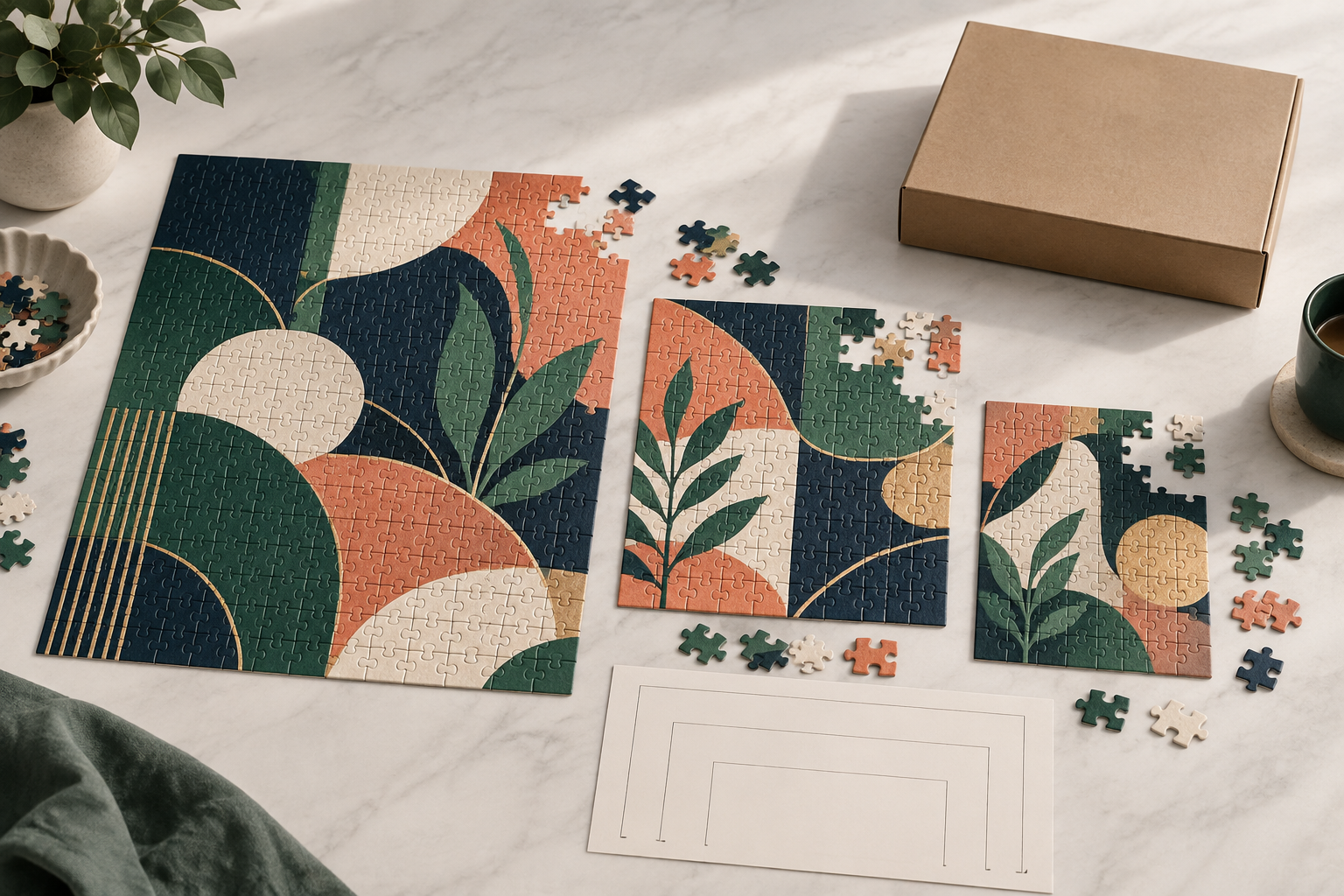
Choose a custom Mahjong-themed puzzle size and piece count together, not as separate decisions. The right combination depends on who will assemble it, how much table space they have, how detailed the artwork is, how challenging the experience should feel, and how the finished product will be packed, stored, gifted, or displayed.
A higher piece count is not automatically better. If many pieces are fitted into a compact finished size, individual pieces become smaller and may be harder to handle. If the same piece count is used for a larger puzzle, the pieces can be larger, but the assembled puzzle requires more working space. The most reliable choice is the one that matches the intended customer and is confirmed on a complete physical sample.
This guide helps retailers, clubs, event organizers, artists, and custom brands prepare a clearer size-and-piece-count brief for American Mahjong Supply.
What do puzzle size and piece count mean?
Finished puzzle size is the width and height of the fully assembled puzzle. Piece count is the total number of individual pieces in the set. Together, these specifications influence approximate piece size, handling, visual detail, difficulty, assembly space, box size, product weight, and production planning.
Two puzzles with the same piece count can feel very different if their finished dimensions, artwork, surface, or cutting pattern are different. Two puzzles with the same finished dimensions can also provide different experiences when the piece count changes.
A useful buyer brief should state:
- Finished width and height
- Portrait, landscape, square, or another approved orientation
- Requested piece count
- Intended user and experience level
- Artwork type and amount of visual detail
- Expected table or display space
- Packaging and storage requirements
- Whether a standard or project-specific cutting approach is requested
Start with the intended user
The intended user should guide the physical specification. A puzzle planned as a detailed adult leisure product may use a different size and piece count from one designed for a club activity, event favor, beginner-friendly gift, or compact retail collection.
- Are users experienced puzzle solvers or occasional participants?
- Will the puzzle be assembled individually or by a group?
- Is easy piece handling important?
- Is the product intended for a long-form challenge or a shorter shared activity?
- Will the puzzle be used at home, at a club, during an event, or as a display item?
- Does the intended market have specific age labeling or product-information requirements that the buyer must supply?
Avoid using age or skill claims that have not been evaluated. Instead, explain the intended experience and ask the supplier to confirm feasible options for the project.
Measure the available assembly space
A finished puzzle needs more than its exact assembled footprint. Users also need room for loose pieces, sorting trays, the box, reference artwork, and hand movement.
- Measure the typical table or work surface available to the user.
- Allow room for pieces to be sorted beside the puzzle.
- Consider whether several people may sit around the same table.
- Check whether the assembled puzzle must fit a standard mat, board, frame, or display area.
- Plan how the unfinished puzzle will be protected between sessions.
For club or event use, test the proposed footprint on the actual table setup whenever possible. A layout that looks comfortable on a large design screen can feel crowded once loose pieces and participant seating are included.
Compare piece count with physical piece size
Piece count should be reviewed in relation to the finished dimensions. Increasing the number of pieces within the same area usually reduces the approximate size of each piece. Increasing the finished dimensions while keeping the same count can make pieces larger, but it also increases the space required for assembly and may change packaging and transportation needs.
Ask the supplier to confirm the available cutting format and expected piece scale for the chosen dimensions. Do not assume that a familiar retail piece count will transfer directly to a different finished size or construction.
During sample review, check whether pieces are comfortable to pick up and turn, easy to separate without damage, large enough for the intended audience to handle, visually distinct enough to sort, and compatible with the approved board thickness and surface treatment.
Remember that difficulty is more than piece count
Piece count is only one part of puzzle difficulty. Artwork structure can make a puzzle easier or harder even when the physical specification remains unchanged.
Difficulty may increase with large areas of similar color, repeated patterns, low contrast, very small details, extensive texture, or few clear visual landmarks. Clear color zones, strong contrast, distinct sections, varied details, and obvious orientation cues can make an image more approachable.
The cutting pattern, piece fit, surface glare, and print clarity also affect the experience. Describe the desired challenge rather than relying on the piece count alone.
Match the format to the artwork
Choose the finished orientation before final artwork is prepared. Confirm the final aspect ratio, main visual focal point, important content that must remain away from trim and cut-sensitive areas, box-front crop, and the legibility of small details at final size.
Request the current supplier template after the physical specification is confirmed. Do not build final production artwork around estimated dimensions. Every photograph, illustration, icon, logo, font, and phrase should be original, licensed, or otherwise authorized for the intended commercial use.
Consider piece handling and accessibility
A practical product should be comfortable for its intended users. Small pieces can provide a detailed challenge but may be less convenient for people who prefer larger pieces or clearer visual separation. A larger finished puzzle can improve piece scale while requiring more table space.
When accessibility matters, review approximate piece dimensions, board thickness and edge feel, contrast and color separation, gloss or glare, ease of lifting pieces, box opening, inner-bag handling, and readability of original product information. Do not make broad accessibility or age-suitability claims without appropriate evaluation.
Plan the box after the puzzle specification
The box should be developed around the confirmed puzzle, not chosen only for visual appearance. Finished dimensions, piece count, board construction, inner containment, inserts, and retail presentation can all affect the box structure.
- Box style and finished dimensions
- How loose pieces are contained
- Whether an authorized reference image or insert is included
- Piece-count and finished-size statements
- Barcode, SKU, label, or buyer-supplied information
- Units per inner pack and export carton
- Storage orientation, shelf requirements, and transportation protection
All box statements should match the approved sample and final specification. Avoid unsupported quality, material, safety, or performance claims.
Review a complete physical sample
A digital proof can confirm spelling, basic layout, and artwork placement, but it cannot fully demonstrate piece handling, cutting, fit, surface appearance, box capacity, or the complete opening experience.
Use a written sample checklist to review finished dimensions and orientation, actual piece count, approximate piece scale, cut consistency, board thickness, piece fit, print clarity, artwork crop, front and back appearance, box fit, inner containment, labels, barcode, SKU, spelling, and pack organization.
Record one consolidated set of comments and identify the sample by date or version. If the finished size, piece count, cut, board, artwork, surface, box, or inner packing changes, ask whether another sample or updated schedule is required.
Plan MOQ and timing with the final configuration
Custom MOQ is confirmed by inquiry because finished size, piece count, cutting, board, artwork versions, surface treatment, box, inner packing, and total quantity can change the production structure. For ready-stock products, 5 sets is the current planning reference, subject to availability and final confirmation.
For planning purposes, a regular custom sample is commonly around 10 days after the specification and production-ready artwork are confirmed. Bulk production for Mahjong-themed puzzles is commonly around 20–25 days after the required approvals are complete.
These are conditional planning references, not fixed delivery promises. Actual timing depends on the specification, artwork readiness, materials, processes, quantity, production schedule, sample feedback, revisions, approvals, and unexpected circumstances. Transportation time is additional.
Custom Mahjong puzzle size and piece count checklist
- Intended user and sales or distribution channel
- Desired assembly experience and challenge level
- Available table, mat, frame, or display space
- Finished width, height, and orientation
- Requested piece count and expected piece handling
- Artwork structure, contrast, focal points, and authorization status
- Current supplier template
- Board, print, surface, cut, and back expectations
- Box, inner containment, labels, barcode, and product information
- Quantity, artwork versions, destination, and target timing
- Sample review and approval responsibility
Frequently asked questions
What is the best piece count for a custom Mahjong-themed puzzle?
There is no single best piece count. The right choice depends on the intended user, finished size, desired challenge, artwork detail, piece handling, available assembly space, and packaging. Confirm the combination with the supplier and review a physical sample.
Does a higher piece count always make a better puzzle?
No. A higher count can create a longer or more detailed challenge, but it can also produce smaller pieces within the same finished area. Usability, artwork, cutting, fit, surface, and packaging are as important as the number itself.
What makes a puzzle difficult besides piece count?
Repeated patterns, large areas of similar color, low contrast, few visual landmarks, small details, glare, and the cut pattern can all affect difficulty. Clear color zones and recognizable original motifs can make sorting more approachable.
Should size be confirmed before final artwork?
Yes. Confirm the finished dimensions, orientation, piece count, and current production template before releasing final artwork. This reduces avoidable cropping, scaling, and safe-area revisions.
What is the MOQ for a custom Mahjong-themed puzzle?
Custom MOQ is confirmed by inquiry because size, piece count, cutting, board, artwork versions, box, inner packing, and quantity affect production planning. Ready-stock products currently use 5 sets as a planning reference, subject to availability and confirmation.
How long does a custom Mahjong-themed puzzle take?
A regular sample is commonly around 10 days, and Mahjong-themed puzzle bulk production is commonly around 20–25 days. These are conditional references. The final specification, artwork, materials, processes, quantity, schedule, feedback, revisions, approvals, and unexpected circumstances can affect timing. Transportation time is additional.
Is a physical sample necessary?
A physical sample is strongly recommended because it allows the buyer to review finished size, piece handling, cutting, fit, board, print appearance, surface, packaging, and the complete user experience before bulk production.
PLANNING A CUSTOM MAHJONG-THEMED PUZZLE?
Share the audience, format, and packaging idea.
Send your intended user, preferred finished size, piece count, desired challenge, authorized artwork status, packaging idea, quantity, destination, and target timing. We can help organize the specifications needed for a practical sample and production review.
Start a project discussion ->Prepare a complete custom puzzle inquiry.