ARTWORK GUIDE · MAHJONG-THEMED PUZZLES
How to Prepare Artwork for a Custom Mahjong Puzzle
A practical checklist for artwork rights, final-size resolution, safe areas, box design, file organization, proofing, and sample review.
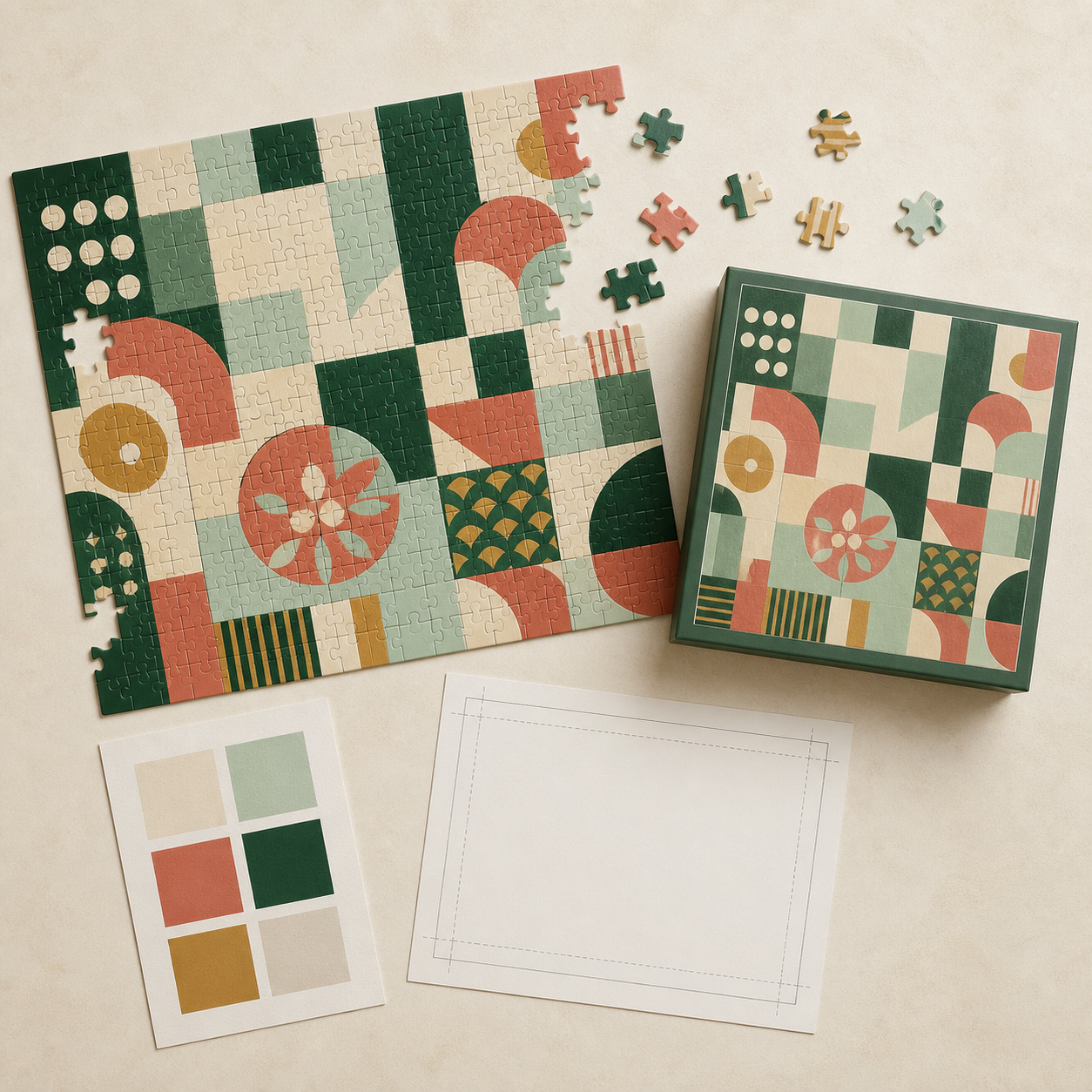
Production-ready custom Mahjong puzzle artwork should be original or properly authorized, sized to the confirmed puzzle and box templates, high enough in resolution for the intended print size, and organized with bleed, safe areas, and clear file labels. The puzzle image and retail box should be prepared as related but separate layouts because they have different dimensions, folds, crops, and information needs.
This checklist is designed for retailers, clubs, event organizers, gift programs, artists, and brands preparing a Mahjong-themed jigsaw puzzle for sampling or custom production.
Start with artwork rights, not file formatting
Before adjusting resolution or color, confirm that every visual element can be used for the intended commercial project. Printing a file does not establish ownership or permission.
Suitable sources may include:
- Original artwork created by the buyer or its in-house team
- Commissioned artwork with written commercial-use rights
- Licensed illustrations, photographs, fonts, and graphic assets
- Brand logos and event marks used with documented authorization
Do not assume that an image found online, a social media post, a vintage-looking illustration, a customer photograph, or a third-party product design is available for commercial printing. Avoid third-party logos, recognizable characters, unlicensed photography, protected instructional content, and designs that imitate another seller's packaging or trade dress.
Keep licenses, artist agreements, and written permissions with the project files. This makes later review easier if the artwork is revised, reused, or expanded into another product.
Confirm the product specification before building the layout
Artwork should be prepared for the actual production specification rather than an estimated canvas. A change in puzzle dimensions, piece count, box style, or box size may require new templates and a revised composition.
American Mahjong Supply currently shows the following reference configuration for its Mahjong-themed jigsaw puzzle:
- Completed puzzle size: 750 × 500 mm
- Piece count: 1,000 pieces
- Puzzle board: 210 gsm white card, 1.2 mm greyboard, and 300 gsm white board
- Finished thickness: approximately 1.7 mm
- Puzzle printing and finish: single-sided CMYK printing with gloss varnish
- Box: 260 × 260 × 52 mm rigid box
- Box printing and finish: CMYK printing with matte lamination
- Packing: shrink wrap and export cartons
These details describe the current reference product, not a universal standard for all custom puzzles. Reconfirm the final specification and obtain the correct production templates before completing the artwork.
Design the puzzle image and box as two separate layouts
The completed puzzle is a flat image. A rigid box is a three-dimensional package with a front, back, sides, edges, folds, and possible label areas. Simply placing the same image into both files can create awkward crops or hide important details.
Puzzle image
The main puzzle image should:
- Match the confirmed finished aspect ratio
- Keep important faces, logos, lettering, and focal objects away from trim-sensitive areas
- Include enough visual variation to support an engaging assembly experience
- Avoid tiny text or delicate details that may not reproduce clearly
- Be reviewed at the intended printed size, not only as a small screen preview
Box artwork
The box layout should clearly separate decorative artwork from product information. Depending on the intended market and sales channel, buyers may need space for:
- Product name and piece count
- Completed puzzle dimensions
- Brand or seller information
- Barcode or SKU area
- Country-specific labels or warnings identified by the buyer
- Side-panel artwork and orientation marks
Labeling requirements vary by destination and sales channel. The buyer should identify the requirements that apply instead of relying on decorative packaging alone.
Use the confirmed template, bleed, and safe area
A production template shows where printing may be trimmed, folded, wrapped, or covered. The file should follow the template supplied for the confirmed specification.
- Trim or cut line: the intended finished edge.
- Bleed area: artwork extending beyond the finished edge to reduce the risk of unprinted slivers after cutting.
- Safe area: the inner zone where essential text, logos, and focal details should remain.
Do not place important text directly against a trim line, box edge, fold, or corner. Background colors and images should normally extend through the required bleed area, while critical elements remain inside the safe area.
Bleed and safe-area dimensions should come from the current production template. Do not copy measurements from an unrelated box or earlier project.
Check resolution at final printed size
An image can look sharp on a phone and still be unsuitable at a 750 × 500 mm printed size. Resolution must be evaluated at the intended physical dimensions.
- Confirm the artwork is placed at the final scale
- Check effective resolution after enlargement or cropping
- Avoid screenshots and heavily compressed web images
- Inspect fine lines, small details, gradients, and text at high zoom
- Keep editable source files and linked assets available
The production team should confirm the required file format, resolution, color profile, and export settings for the approved specification. Do not enlarge a small raster image and assume that added pixels restore lost detail.
Prepare color and finishing expectations
Screen colors are produced with light, while printed colors depend on ink, material, coating, and production conditions. A monitor preview should not be treated as an exact guarantee of the finished result.
- Use the requested color mode and profile
- Identify brand colors that require special attention
- Avoid relying on extreme screen brightness or neon-like effects
- Check dark areas for lost detail and light areas for insufficient contrast
- Review how gloss varnish on the puzzle and matte lamination on the box may create different visual impressions
If color matching is important, state the expectation before sampling and review the physical sample under suitable lighting.
Keep text and logos legible
Puzzle artwork may be highly decorative, but packaging information still needs a clear hierarchy. Use readable type sizes, sufficient contrast, and restrained text placement.
Check the product name, piece count, completed size, box size, authorized logo, spelling, barcode area, buyer-supplied contact information, and required market-specific text. Convert or package fonts according to the production team's instructions so missing fonts do not cause substitutions or spacing changes.
Organize the final handoff
A clear file structure reduces avoidable questions and helps the sample reflect the approved concept. Recommended handoff folders include:
01_Puzzle_Artwork02_Box_Artwork03_Linked_Images04_Fonts_or_Licenses05_Reference_Preview06_Read_Me
The read-me file can identify the specification, version date, orientation, special color notes, packaging information, and the single set of files intended for production.
Avoid filenames such as final-final-new-2. Use a clear naming system with the product, component, version, and date. Remove obsolete exports from the production folder so the approved version is unambiguous.
Review a physical sample before bulk production
A digital proof can confirm layout and text, but a physical sample is more useful for reviewing printed color, image clarity, cutting, piece fit, board appearance, box construction, lamination, and packing presentation.
Review the sample against a written checklist. Record requested changes in one consolidated document and mark each revision clearly. After changes are made, confirm the final approved files and sample status before bulk production begins.
A custom sample normally takes about 10 days after the specification and production-ready artwork are confirmed. Bulk production for Mahjong-themed puzzles generally takes about 20–25 days after required approvals are complete.
These are conditional planning estimates, not guaranteed completion or arrival dates. Actual timing depends on the specification, artwork, processes, quantity, revisions, approvals, production schedule, packing, and other project conditions. Unexpected circumstances may add several days, and transportation time is separate.
Common artwork handoff mistakes
- Starting before the specification is confirmed. A changed puzzle or box size may require a redesigned layout.
- Using artwork without commercial permission. File access is not the same as usage rights.
- Sending one flattened preview as the only file. Editable production files and linked assets may still be required.
- Ignoring box panels and folds. Important text can be cropped, wrapped, or placed upside down.
- Using small web images. Screen appearance does not confirm print suitability at full size.
- Putting essential details outside the safe area. Cutting and wrapping require production tolerance.
- Leaving multiple competing final files. The production version should be unmistakable.
- Treating a digital preview as a physical sample. Material, printing, finishing, cutting, and assembly need separate review.
Production-ready artwork checklist
- Final puzzle specification and current templates received
- Artwork is original, licensed, or otherwise authorized
- Puzzle and box files are prepared separately
- Layout matches the confirmed finished dimensions
- Bleed is extended and key elements remain inside safe areas
- Effective image resolution is suitable at final size
- Color expectations and important brand colors are documented
- Text, dimensions, and piece count are accurate and legible
- Fonts and linked assets are packaged as instructed
- Barcode, SKU, and destination-market information are allocated correctly
- Files use clear version names and obsolete versions are removed
- A reference preview and read-me file are included
- Physical sample review criteria are prepared
Frequently asked questions
Can the same image be used on the puzzle and the box?
The same authorized artwork can support both components, but the layouts should be prepared separately. The puzzle is flat, while the box has different dimensions, panels, edges, folds, and information areas.
What size is the current American Mahjong Supply puzzle reference?
The current reference configuration is a 1,000-piece puzzle with a completed size of 750 × 500 mm and a 260 × 260 × 52 mm rigid box. Custom projects should reconfirm the specification and template before artwork is finalized.
Is a high-resolution JPEG enough for production?
It may be suitable for part of a project, but file requirements depend on the layout, editing needs, scale, color settings, text, box construction, and production workflow. Confirm the required formats before final export.
How close can text be to the edge?
Essential text should remain inside the safe area shown on the current production template. Exact safe-area and bleed dimensions must be confirmed for the selected puzzle and box specification.
Can artwork found online be printed on a custom puzzle?
Only when the buyer has the necessary commercial-use rights or authorization. Online availability does not establish permission to reproduce an image, logo, character, photograph, or design.
How long do sampling and bulk production take?
A custom sample normally takes about 10 days after the specification and production-ready artwork are confirmed. Puzzle bulk production generally takes about 20–25 days after required approvals. These are conditional estimates, and transportation time is additional.
PREPARING A PUZZLE PROJECT?
Share your artwork plan.
Send the intended use, confirmed or preferred specification, quantity, artwork status, box requirements, destination, and target schedule for a product-specific file and production review.
Start an inquiry ->Plan the retail and gift presentation for a custom Mahjong-themed puzzle.